Safe Canning: Avoiding Botulism with Vegetables, Meat and Mushrooms
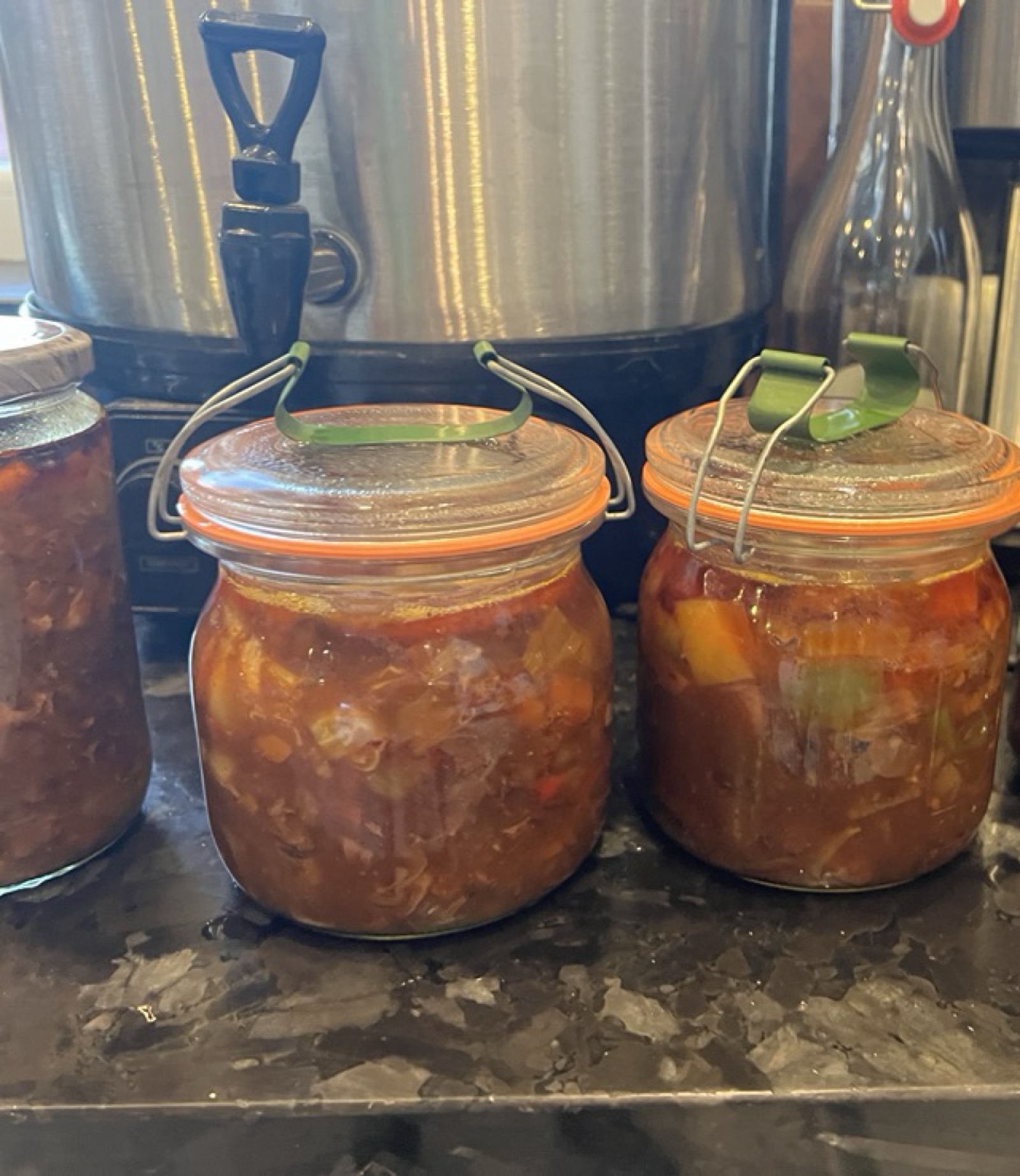
Canning is one of the most satisfying things you can do in your own kitchen. The pantry fills up, nothing spoils, and in February summer tastes of summer all over again. With some foods, though, there is a risk that is discussed surprisingly rarely - and when it is, usually with half-knowledge.
The subject is botulism. The illness is rare but severe, and it can be fatal. Germany's Federal Institute for Risk Assessment (BfR) traces a large share of the cases reported in humans back to home-canned preserves. That is no reason to stop canning. It is a reason to understand exactly where the line runs.
The good news first: for a large part of what gets canned in home kitchens - jam, stewed fruit, pickled gherkins - the risk is very low. You just need to know why.
The physical problem
Clostridium botulinum is a bacterium that lives without oxygen. A sealed preserving jar is an extremely comfortable home for it. There it produces a nerve toxin that takes effect in minute quantities.
The bacterium itself is not especially tough. It does not survive proper heating. The problem is its spores - a kind of dormant form in which it withstands heat and dryness for long periods. These spores are everywhere in soil, so they cling to more or less anything that comes out of the garden.
Killing them reliably takes around 121 °C. And this is exactly where the difficulty lies: at normal atmospheric pressure, water gets no hotter than 100 °C. However long you boil it. The automatic canner cannot manage it, the pot cannot, the water bath cannot.
The oven does not help either, though this is often assumed. The air in the oven does get hotter, but the contents of the jar consist mostly of water - and that stops at 100 °C. What counts is the temperature inside the jar, not the one on the thermostat.
From this follows something important: the processing time does not determine whether the spores die. Two hours at 100 °C kill them just as little as twenty minutes. Anyone who sees a table of long processing times and infers safety from it has misunderstood the mechanism.
The one question that decides everything
If it is not the time - then what?
The acidity. Clostridium botulinum cannot multiply in an acidic environment. The threshold is a pH of 4.6. Below it the bacterium stays harmless, even if spores are in the jar. Above it, it can become active.
High-acid (pH below 4.6) - unproblematic in a water bath:
- Most fruit: apples, berries, cherries, plums, rhubarb
- Jam and jelly
- Anything pickled with enough vinegar: sour gherkins, mixed pickles, beetroot in vinegar brine
- Fermented foods such as sauerkraut or kimchi, where lactic acid fermentation lowers the pH
Low-acid (pH above 4.6) - this is where the risk lies:
- Beans, peas, sweetcorn
- Carrots, pumpkin, celery, asparagus
- Mushrooms
- Meat, game, poultry, fish
- Most tomato varieties sit right at the threshold and are not considered safe without added acid
A few special cases are worth noting: melons and ripe mangoes sit above the threshold despite being fruit, and so do pears depending on the variety. pH values also vary generally - with variety, ripeness and growing year. This classification is a guide, not a guarantee in the individual case.
Route A: canning high-acid foods
Here the usual approach is the right one. Work cleanly, clean jars, intact rubber seals, automatic canner or pot, done.
The processing times given by manufacturers and in good canning books can be used here - they govern texture and shelf life against mould and yeasts. With high-acid produce, the time is therefore a question of quality, not of safety. Cherries left in for twenty minutes too long turn mushy, not dangerous.
Route B: low-acid foods with a pressure canner
Anyone who genuinely wants to preserve beans, mushrooms or meat safely cannot avoid a pressure canner. Under pressure the boiling point rises, which makes the necessary 121 °C achievable. For low-acid produce, this is exactly what the BfR recommends.
In Germany the appliance is not widespread - in the United States the pressure canner is standard in self-sufficient households. An ordinary pressure cooker is not automatically the same thing: it does reach pressure, but it is usually not designed for canning jars and not built for a controlled holding time. Anyone going down this route should choose an appliance explicitly intended for canning and follow the manufacturer's instructions.
Route C: low-acid foods without a pressure canner
For everyone who does not have one - that is, most people - the BfR recommends a two-stage approach: heat the preserves to 100 °C twice in total, one to two days apart, leaving them at room temperature in between.
The thinking behind it: the first round kills the active bacteria. During the pause, surviving spores germinate - and in that vulnerable state they are caught by the second heating.
This lowers the risk considerably. It does not eliminate it entirely. Anyone doing this should know that they are not achieving the same safety as with pressure. For many that is a defensible trade-off - but it should be a conscious one.
The rule that always applies
Whichever route you take, and this is the most important paragraph in this article:
Heat low-acid preserves right through to 100 °C before eating them.
Unlike the spores, the nerve toxin is heat-sensitive. Bringing it to the boil destroys it. This single habit catches the case where something went wrong during canning - and it costs nothing but a few minutes at the stove.
So the beans from the jar belong in a pot, not cold into a salad.
Why your eyes and nose are not enough
The most widespread misconception: surely you would notice. The lid bulges, it smells odd, the jar hisses when opened.
With some strains that is true. With others it is not. There are variants of Clostridium botulinum that form the toxin without producing gas - the jar stays completely inconspicuous from the outside, the vacuum intact, smell and taste unchanged. So you cannot rely on your senses.
The reverse still holds, though: a bulging lid is an unambiguous warning sign. Do not open such jars, do not taste them, do not smell them - dispose of them.
One more note: vegetables and herbs in oil
A side topic with the same mechanism. Oil excludes oxygen, and that creates precisely the environment in which Clostridium botulinum thrives. The BfR advises against preserving and storing vegetables and herbs in oil.
If you still want to make herb oil or preserved garlic: keep it in the fridge and use it up promptly, rather than letting it stand in the cupboard for months.
In summary
Canning is safe as long as you know which of the two camps you are in.
Fruit, jam and anything with a decent amount of vinegar: unproblematic, a water bath is enough.
Beans, mushrooms, meat and the rest of the low-acid contingent: either a pressure canner, or heat twice and accept that a residual risk remains - and in every case bring it to the boil before eating.
The rest is craft: clean jars, intact seals, careful work. That can be learned, and it is worth it.
Source and further information: German Federal Institute for Risk Assessment (BfR) - FAQ on botulism (in German)
This article reproduces the recommendations of the BfR, which apply to Germany, and does not replace individual advice. In case of doubt, or if you suspect a preserve has spoiled, the rule is: dispose of it rather than taste it.