Balcony Solar with Battery Storage: Power from Your Own Balcony
A balcony power plant – also called plug-in solar – is the easiest way to generate your own solar power. With an additional storage battery, you can use the energy you generate even when the sun isn't shining.
What Is a Balcony Power Plant?
A balcony power plant consists of one or two solar panels (400–600 W each) and a micro-inverter that converts the panels' DC current into standard 230 V household AC current. You simply plug it into a normal wall socket – done.
Why Add a Storage Battery?
Without storage, the power plant feeds directly into the household grid during the day. Surplus power you aren't using at that moment flows unused into the public grid (without compensation). A storage battery buffers this surplus and releases it in the evening or at night – raising your self-consumption rate to as much as 80–90%.
Legal Basics
Since 2024, simplified rules apply in Germany:
- The inverter's feed-in power may not exceed 800 watts, the module output 2,000 watts peak – that has been the rule since May 2024 (Solarpaket I)
- You only register in the Marktstammdatenregister (market master data register; free, online in a few minutes) – the separate notification to the grid operator has been dropped
- Tenants need the landlord's consent – since 2024 tenants have a legal right to it
- An old Ferraris meter may keep running for a transitional period until the grid operator swaps it for a two-way meter
- In most German states no building permit is required – but each state regulates that for itself
Components at a Glance
| Component | Typical Output | Cost |
|---|---|---|
| Solar panel (1–2 units) | 400–600 W per panel | €80–150 per unit |
| Micro-inverter | up to 800 W | €50–120 |
| Storage (optional) | 1–2 kWh | €400–900 |
| Mounting (balcony/wall) | – | €30–80 |
Setup Step by Step
- Choose a location – south-facing is optimal, southwest/southeast works well. At least 4 hours of direct sun per day.
- Mount the panel – use balcony brackets with clamps or a ground stand. A tilt angle of 30–45° is ideal.
- Connect the inverter – connect MC4 connectors, plug the inverter into an indoor extension cable via the wall socket.
- Integrate the storage battery – place it between the panel and inverter, or as a standalone system with its own inverter.
- Register it – an entry in the Marktstammdatenregister is all it takes.
What Does It Really Get You?
Example calculation for 800 W peak + 1.6 kWh storage in southern Germany:
- Annual generation: approx. 700–900 kWh
- Self-consumption with storage: approx. 600–750 kWh
- Savings at 32 cents/kWh: approx. €190–240 per year
- Payback period: approx. 4–6 years
Practical Tips
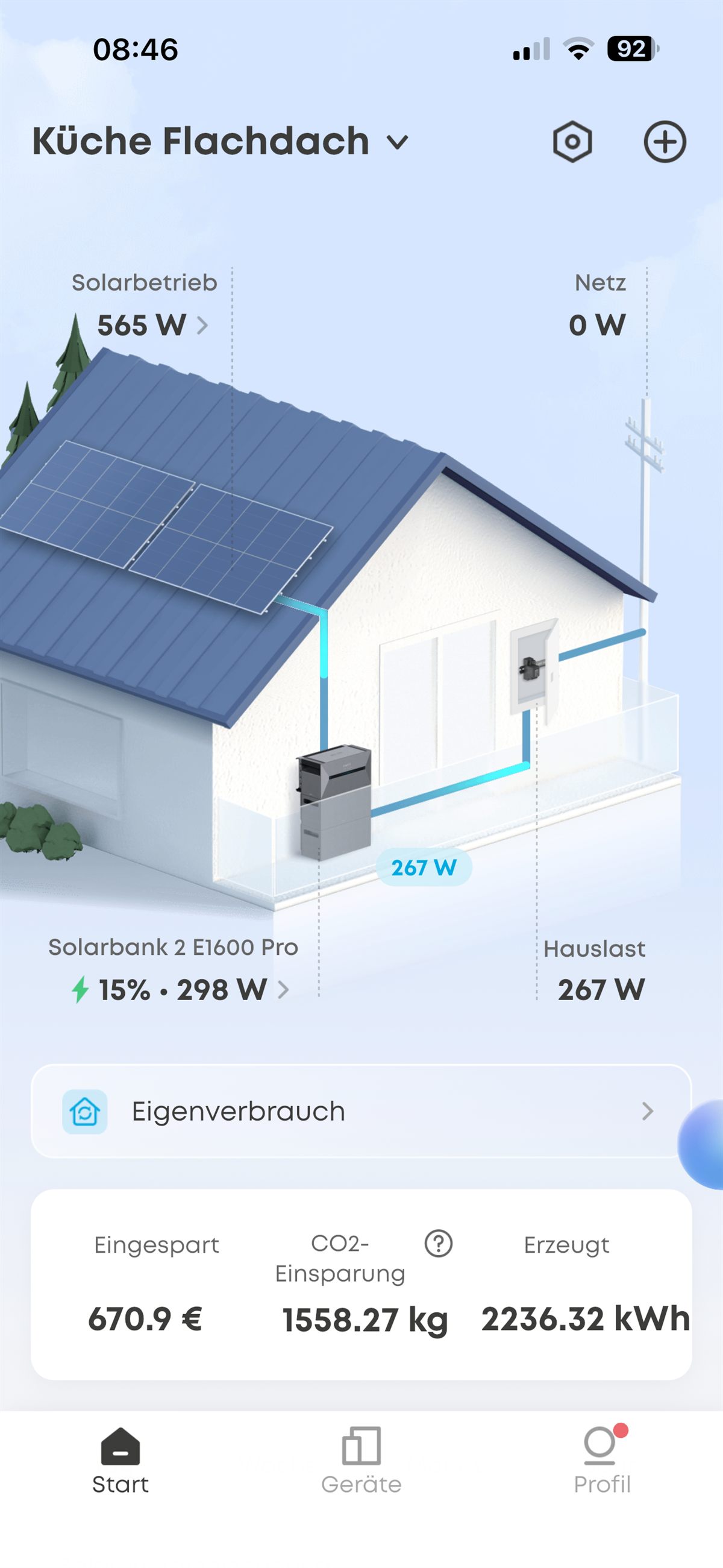
- Use app monitoring – many storage batteries have apps with live data on generation, consumption and charge level
- Time your appliances – run the washing machine or dishwasher during the day
- Avoid shade – even a small shadow on one panel noticeably reduces output
- No permanent extension cords – it's better to have a proper outdoor socket installed