The 10 Most Common Edible Mushrooms in Profile
The Best Edible Mushrooms for Beginners
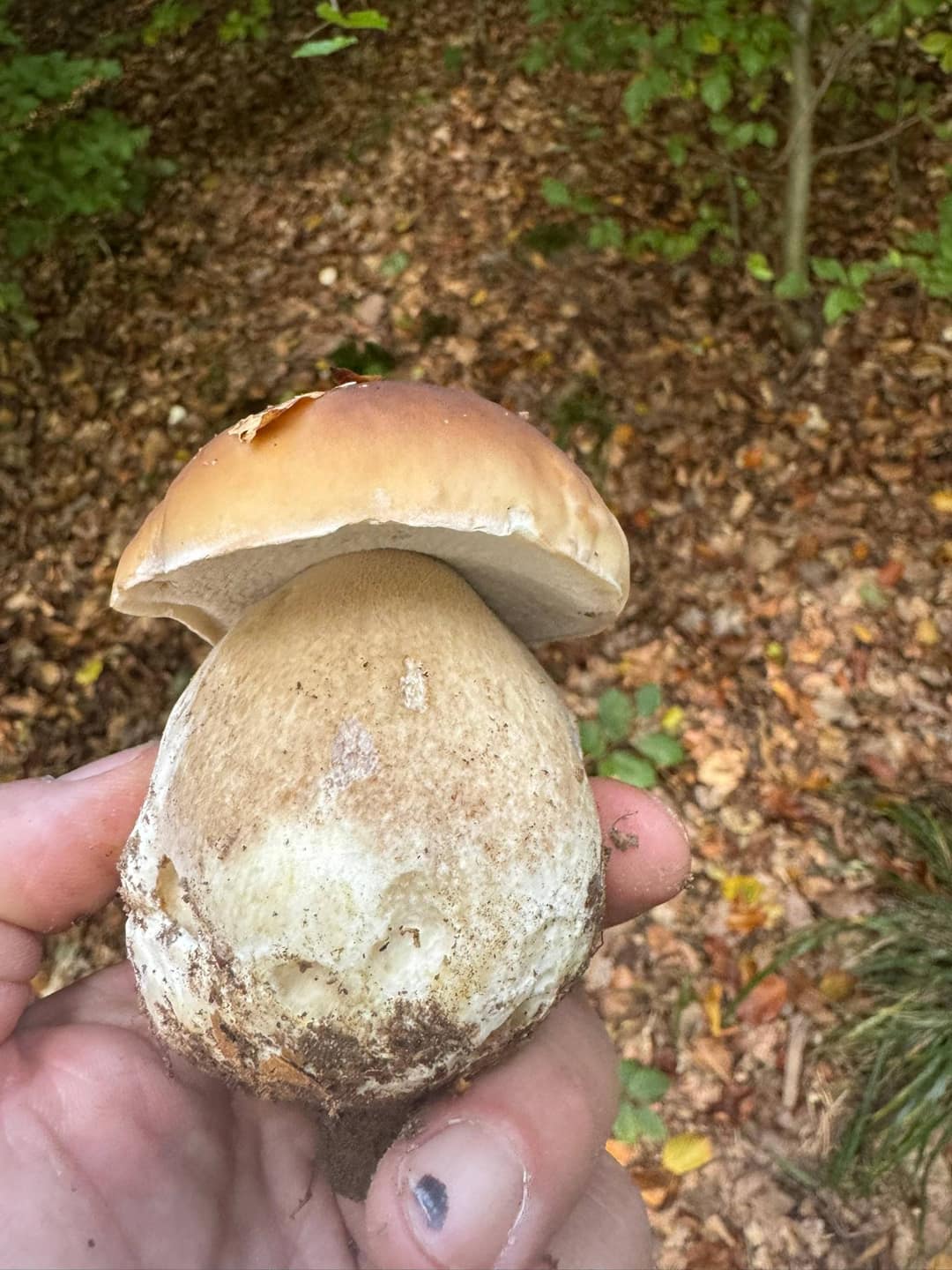
1. Porcini
Brown cap, net-like pattern on the stem, whitish-yellow pores. Pleasant mushroom smell. Spruce and pine forests, August–October. The most common mix-up is the inedible bitter bolete: bitter in taste, with a dark net on a pale stem and pores that turn pink with age. Check the stem pattern and pore colour together, and leave anything doubtful where it is.
2. Chanterelle
Egg-yolk yellow, funnel-shaped cap, ridges instead of gills, fruity apricot-like scent. June–October. The false chanterelle is a deeper orange and has true, sharp-edged gills that fork repeatedly; the poisonous jack-o'-lantern grows in tufts on wood and roots and also has true gills. Check the underside and where it is growing together, and leave anything doubtful where it is.
3. Bay Bolete
Chestnut-brown cap, bruises slightly blue when cut. A common porcini substitute in coniferous forests. Here too the bitter bolete is the most common mix-up – it does not bruise blue and its pores turn pink with age.
4. Parasol Mushroom
Very large cap (up to 30 cm), scaly brown, movable ring. On forest edges and clearings. Careful: poisonous false parasols (Chlorophyllum species) stain reddish when cut or at the stem base and prefer fertilised ground, gardens and compost edges; very young, still-closed specimens can also be mistaken for amanitas. So only take mushrooms whose cap has opened out, check several features together, and leave anything doubtful where it is.
5. Field Mushroom
White cap, pink to brown gills, pleasant smell. On meadows and pastures.
Careful – this is where the most common deadly mushroom mix-up happens: young death caps also have a white cap and gills that are still pale. Their stem carries a ring and sits at the base in a bulb wrapped in a membranous sac, and their gills stay white for good. Field mushroom gills, by contrast, turn pink and then chocolate brown, and it never has such a sac – so always dig the whole stem out instead of cutting it off. If a supposed field mushroom stains yellow at the stem base and smells of ink or carbolic, it is a yellow-stainer: poisonous, it causes stomach and bowel upsets.
6. Birch Bolete
Brown cap, black-and-white stem. Always found near birches, July–October.
7. Red-Capped Scaber Stalk
Orange-red, flesh turns blue-grey when cut. Found near aspens and poplars.
8. Wood Hedgehog
Cream-yellow, spines instead of gills. There are only a few similar species. September–November.
9. Horn of Plenty
Dark brown to black, funnel-shaped. Intense flavor, excellent dried.
10. Giant Puffball
White ball up to the size of a football. Cut every find in half lengthways: a puffball is pure white and completely uniform inside – if the cut instead shows the outline of a mushroom with cap, gills and stem, it is a young amanita, possibly a death cap. Check the shape and the cut surface together, and leave behind anything you cannot place with confidence.
Golden rule: Only pick what you can identify with certainty. When in doubt, ask a mushroom expert!