Hot-Smoking Fish
Hot Smoking Fish
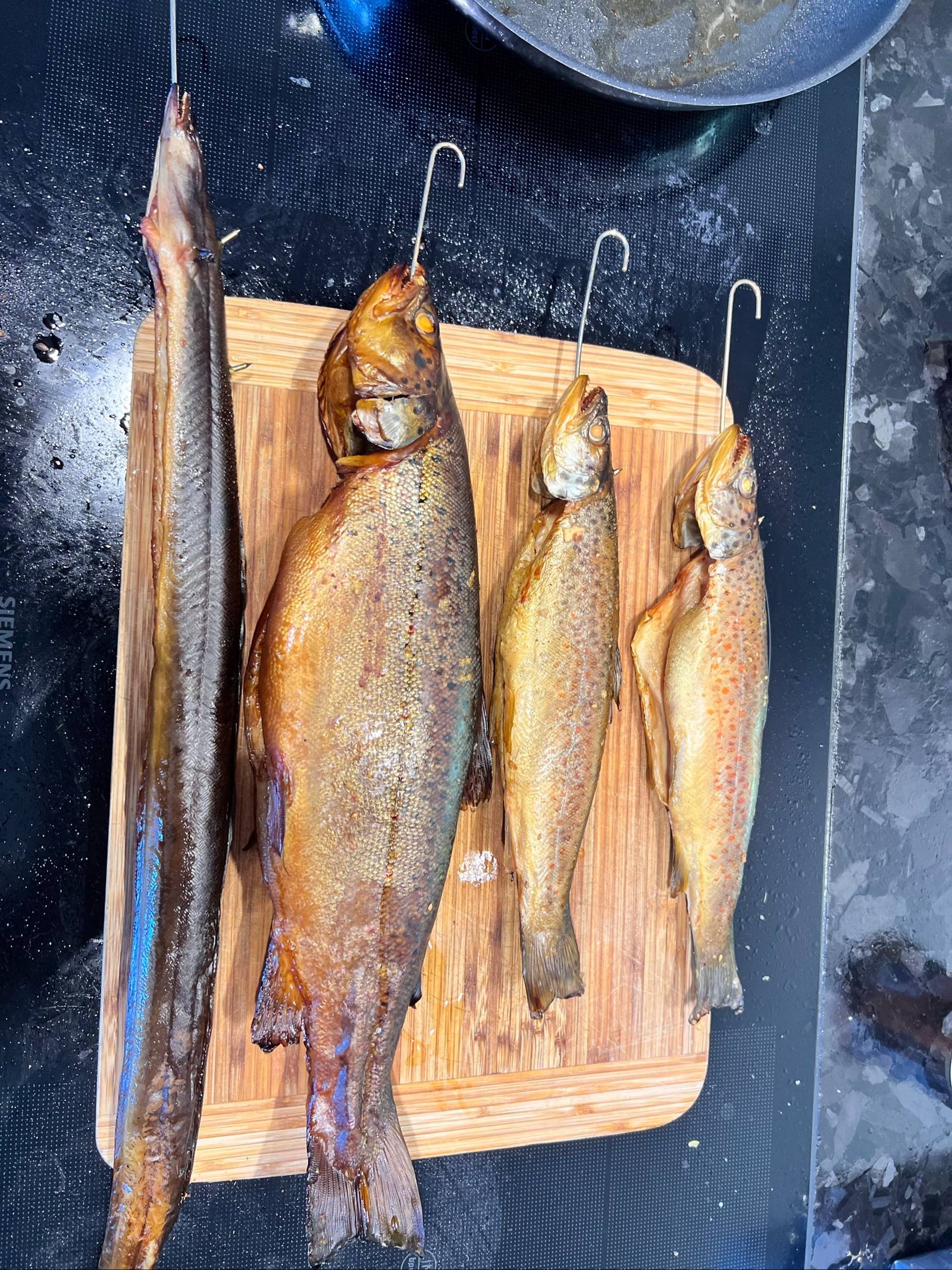
From the brine to the finished trout: step by step through the smoking process. Hot smoking is the most accessible form of smoking – the fish cooks while absorbing smoke. The result: tender, aromatic fish with golden-brown skin that you can eat right away.
Hot smoking vs. cold smoking
Before we get into practice, the key difference:
| Hot smoking | Cold smoking | |
|---|---|---|
| Temperature | 60–90 °C (140–194 °F) | below 25 °C (77 °F) |
| Cooking time | 1–3 hours | 12–48 hours |
| Result | Cooked, ready to eat immediately | Raw, preserved |
| Shelf life | 3–5 days (refrigerated) | 1–2 weeks (refrigerated) |
| Suitable for beginners | Very good | More demanding |
This article covers hot smoking only.
The smoker
There are various types of smokers – from inexpensive tabletop smokers to large cabinet smokers.
Tabletop smoker (beginners):
- Stainless steel, compact
- For small quantities (2–4 trout)
- Works on a camping stove or grill
- Price: €20–60
Cabinet smoker (medium to large quantities):
- Made of aluminized or stainless steel – galvanized steel has no place in a smoker because of the zinc
- Several racks for 10–20 fish at once
- Its own tray for wood chips
- Price: €80–300
DIY solutions: An old steel drum, a retired refrigerator, or a sheet-metal box – with a bit of handiwork, these alternatives work well. With a fridge, only old all-metal interiors will do: the plastic linings and foam insulation of modern appliances give off harmful fumes when heated and have to come out completely.
Smoking wood: where the flavor comes from
The smoking wood is decisive for flavor and color. Only untreated hardwoods are used – softwoods contain resins that make the fish inedible.
| Wood type | Aroma | Best with |
|---|---|---|
| Beech | Mild, all-purpose | Trout, eel, mackerel |
| Alder | Slightly sweet | Salmon, trout |
| Cherry | Fruity, aromatic | Pale fish, char |
| Oak | Strong, spicy | Eel, carp |
| Apple | Sweet-fruity | Trout, char |
Forms: Wood chips, smoking meal (fine sawdust), or smoking sticks – the smaller the pieces, the faster they burn.
Step 1: The brine (wet curing)
The brine gives the fish flavor, draws out water, aids preservation, and forms the basis for that characteristic smoked skin.
Basic brine
For approx. 1 liter (enough for 2–4 trout):
- 1 liter water
- 60–80 g salt (not iodized!)
- 1 tsp sugar
- Optional: bay leaves, peppercorns, juniper, garlic, dill
Dissolve salt and sugar in cold water. The brine must be clear and fully dissolved.
Brining the fish
- Prepare the fish (gutted, washed)
- Submerge it completely in the brine – the fish must be fully covered (weigh it down if needed)
- Brine in the refrigerator: Trout (300–500 g): 8–12 hours, larger fish longer
Step 2: Drying
After brining: remove the fish from the brine, rinse well (to avoid too salty a taste), pat dry.
Then let it dry: at least 2–4 hours in the open air (or in front of a fan, out of direct sun). The surface must be dry – only then will the glossy, golden skin (pellicle) form during smoking.
Without a dry surface: smoke sticks poorly, and the skin turns blotchy and damp instead of glossy.
Step 3: Preparing the smoker
- Soak the wood chips (optional): soak in water for 30 minutes so they smolder longer instead of burning up immediately
- Clean the smoker, empty the drip tray
- Place the fish on the racks – not too close together, air must circulate
- Add wood chips to the tray (about a handful for small smokers)
Step 4: Smoking
Phase 1: Cooking phase (higher temperature)
- Slowly bring the smoker to 70–80 °C (158–176 °F)
- The fish must cook all the way through in this phase – the core temperature needs to reach at least 70 °C (158 °F)
- Duration: approx. 30–45 minutes depending on quantity and size
Phase 2: Smoking phase (slightly lower temperature)
- Only once the fish is cooked through, reduce the temperature to 60–70 °C (140–158 °F)
- Add wood chips, close the lid
- Duration: 1–1.5 hours for trout
Doneness test
The fish is done when:
- The dorsal fin pulls out easily
- The flesh along the back is white, no longer translucent
- The core temperature at the thickest point reaches at least 70 °C / 158 °F and holds there for 10 minutes (insert a kitchen thermometer)
Step 5: Resting and serving
After smoking: let the fish rest 20–30 minutes so the smoke can settle and the juices redistribute. Don't cut into it right away.
Serving: Hot-smoked trout tastes great warm, straight from the smoker – with horseradish, lemon, and fresh bread. Or cold as a cold cut, in salads, or on pretzel rolls.
Common mistakes
Fish tastes bitter → Smoking wood burned instead of smoldering; vents closed too far; resinous wood used
Skin tears, looks blotchy → Fish wasn't dry enough before smoking; initial temperature too high
Fish is still raw inside → Temperature too low; smoking time too short; fish placed too close together
Shelf life & storage
Freshly smoked fish keeps in the refrigerator for 3–5 days – vacuum-sealed up to 2 weeks, but only at a constant temperature below 3 °C (37 °F). Frozen, up to 3 months.
Vacuum-sealing after smoking significantly extends shelf life and is recommended for larger smoking batches. One thing belongs with it, though: a vacuum means no oxygen, and Clostridium botulinum type E multiplies in smoked fish even at refrigerator temperatures. So vacuum-sealed fish has to stay below 3 °C (37 °F) throughout – or go into the freezer.
Conclusion
Hot smoking is an ancient craft with a surprisingly simple technique. Once you bring self-smoked trout to the table, you'll want to do it again and again. The combination of fresh fish, wood of your own choosing, and a homemade brine produces something no supermarket can offer.