Trout Fishing: Fly Fishing & Spin Fishing in the Stream
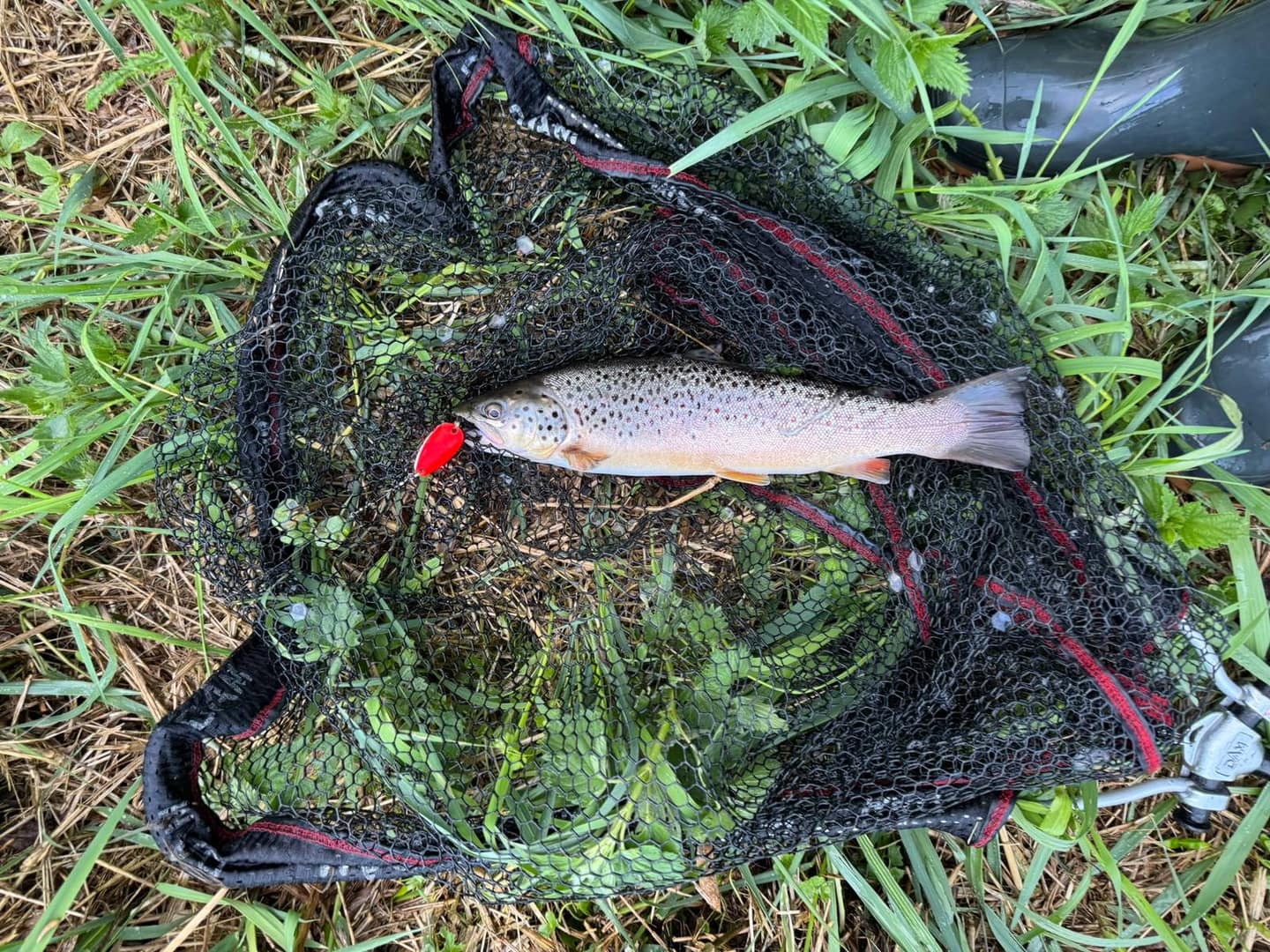
Trout fishing – precision and patience by the water
Trout are considered the most demanding freshwater fish. They live in clear, oxygen-rich waters, are extremely wary, and react sensitively to mistakes. Anyone who can outsmart them has proven real angling skill.
Trout species at a glance
Brown trout (Salmo trutta fario):
- The most common trout species in German streams and rivers
- Bright red and black spots, golden-yellow flanks
- Very site-faithful – knows every stone in its territory
Rainbow trout (Oncorhynchus mykiss):
- Originally from North America, now widespread
- Typically a pink longitudinal stripe and black spots reaching into the tail fin – check several features together to tell it apart from brown trout
- Somewhat less wary than brown trout
Lake-run brown trout:
- Migratory form of brown trout, lives in the lake, spawns in streams
- The largest form of brown trout, can exceed 10 kg
Method 1: Spin fishing
The easiest entry point into trout fishing for beginners.
Equipment:
- Light spinning rod, 1.8–2.4 m, casting weight 3–15 g
- Spinning reel with 0.16–0.20 mm monofilament or 0.06–0.08 mm braided line
- Lures: small spinners (Mepps Aglia No. 1–2), spoons, mini wobblers
Technique:
- Cast the lure across the current, retrieve slowly with the flow
- Vary retrieval speed – trout respond to combinations of stimuli
- Wading with wading boots allows more precise positioning
Method 2: Fly fishing
The discipline of kings – and at the same time the most natural method.
Principle: An almost weightless artificial fly is cast using the weight of the fly line – not the weight of the lure.
Basic equipment:
- Fly rod, 7–9 feet, weight class 4–6
- Fly line matched to the rod's weight class (WF = weight forward)
- Leader 2–3 m, tapering down to 0.12–0.16 mm
- Flies: dry flies (float on top), nymphs (fished underwater)
Tip for beginners: Learn the basic cast with practice casting before heading to the water – casting lessons are worthwhile.
Where do trout hold?
- Behind and in front of rocks – low-current zones
- Under overhanging banks – cover and insect drop zones
- Inflow zones (where a stream flows into a pond)
- Outer bends with deep water
Closed season & minimum size
Varies by state and body of water – ask the fishing rights holder or check your permit! Typical: brown trout closed season March–April, minimum size 25–30 cm.